Inquiry-Based Teaching in Life Sciences
Go!
3.1
The relevance of new discoveries in the life sciences
Give more examples of how new discoveries in other fields can relate to and contribute to the advancement of life sciences. Can you think of ways in which this could be taught in an interdisciplinary way?
I think that today the use of technologies in scientific research is very important, both for specific instruments and for data collection. The possibility to communicate and share quickly the discoveries of the individual researcher is also very important for the collaboration.


Philosophy for Children (P4C) is an approach that prompts critical thinking among students, where they get the opportunity to employ other key life skills, such as communication, creativity and collaborating with others. The idea is that by engaging in philosophical inquiry, students can better prepare to become citizens in society. Although the name suggests that P4C is for primary school children, it is actually a method widely used among high school teachers.
A P4C can include the following sequence of steps:
- Warm-up (could involve introductions or an icebreaker game)
- Stimulus (we will use a video clip later in the module, but it can range from a newspaper article to a photograph)
- Private reflections (thinking time on stimulus)
- Question creation (individually developing a question related to a stimulus)
- Question-airing (collaborating in separate groups to describe the generated questions; the most relevant question from those generated within the group can be picked by consensus)
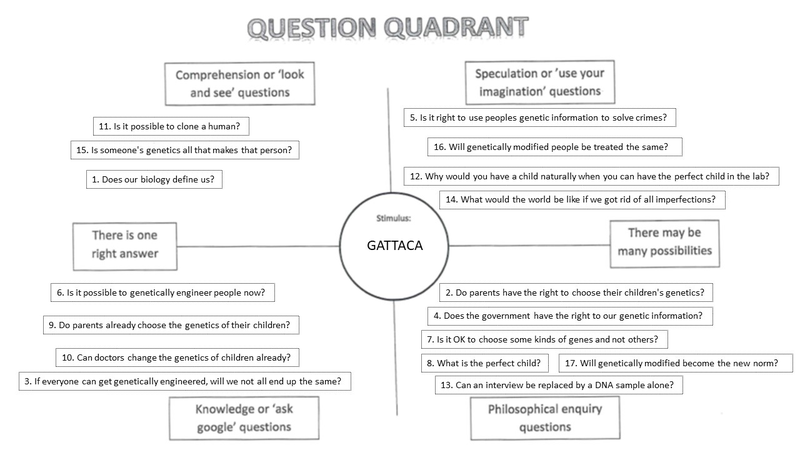
- Question-choosing (sorting and classifying the questions generated by all groups as philosophical or otherwise; we will use a quadrant to do this; one philosophical question is chosen by the whole class on a vote)
- First thoughts (on the question chosen by students in the class)
- Inquiry (students may sit in a circle and inquire on the question while the teacher acts as a facilitator)
- Last words
- Review and evaluation of the process/content

Take some time to reflect on what questions arise for you after watching the trailer - write 3-4 of these down in this forum thread. At this point, you have carried out steps 2 to 4 from this sequence.
The first questions that I can think of are:
- Would I have been a valid or invalid individual?
- I would like to live in a society where the only purpose is perfection?
- How far is this future from our present?
It is important for students to learn to identify philosophical questions.
Philosophical questions:
- are not answered through scientific investigation or accumulation of factual knowledge and information
- are open to examination, further questioning and inquiry
- look at meaning, truth, value, knowledge and reality